As businesses scale, the complexity of infrastructure increases, making it essential to adopt dynamic, scalable systems that can meet growing demands efficiently. Infrastructure as Code (IaC) enables infrastructure management through code, bringing automation, consistency, and scalability to the forefront of modern operations.
In this blog, we’ll dive into IaC fundamentals, compare popular tools like Terraform and CloudFormation, and discuss best practices for managing infrastructure at scale.
What is Infrastructure as Code (IaC)?
Infrastructure as Code (IaC) is a method of managing computing resources through configuration files rather than manually adjusting physical hardware or interactive tools. By treating infrastructure as code, organizations achieve consistent, version-controlled, and reusable infrastructure setups. This approach integrates well with DevOps, allowing teams to automate deployments with the same efficiency as they would with software.
Why Use IaC?
- Consistency and Standardization
IaC ensures consistent infrastructure across environments, reducing “configuration drift.” This standardization allows for faster, error-free environment setups with predictable outcomes. - Version Control and Collaboration
IaC configurations can be stored in repositories like Git, making collaboration easier. Teams can review, track, and audit changes, providing a clear history and transparency over the infrastructure lifecycle. - Automation and Efficiency
With IaC, infrastructure provisioning becomes automated, eliminating error-prone manual configurations. This efficiency is especially valuable for large or multi-cloud setups. - Cost Optimization
IaC enables automated scaling, reducing costs by provisioning resources only when needed and avoiding over-provisioning.
Popular IaC Tools: Terraform vs. CloudFormation
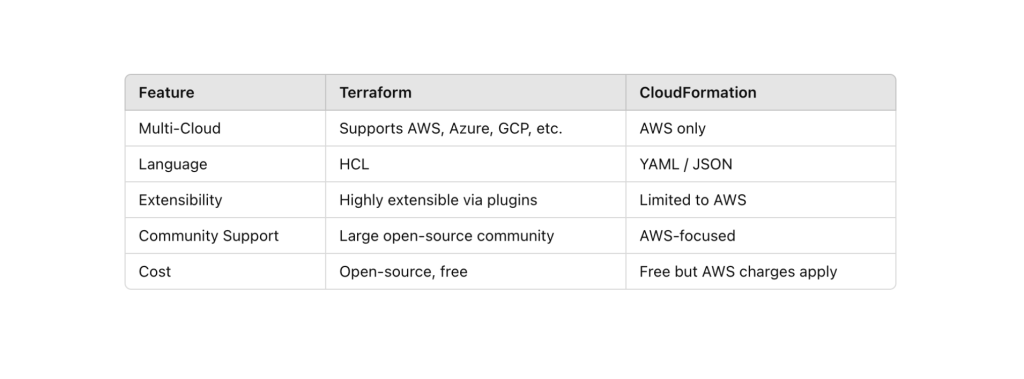
There are many tools in the IaC space, but Terraform and CloudFormation are among the most popular.
1. Terraform
Overview: Developed by HashiCorp, Terraform is an open-source IaC tool that supports multiple cloud providers, including AWS, Azure, and GCP, as well as on-premises environments.
Key Features:
- Multi-Cloud Support: Terraform can manage resources across various cloud providers, ideal for hybrid or multi-cloud architectures.
- Declarative Language: Uses HashiCorp Configuration Language (HCL), which is easy to read, modular, and supports reusable components.
- Extensibility: Its plugin-based architecture allows for extensive customization and third-party integrations.
- Plan and Apply: Terraform’s “plan” function allows users to see changes before applying them, catching potential issues early.
Ideal Use Cases:
- Managing multi-cloud infrastructure
- Environments requiring reusable, modular configurations
- Teams looking for a large community-supported tool with flexibility
2. CloudFormation
Overview: AWS CloudFormation is Amazon’s IaC solution, designed specifically for AWS environments. It seamlessly provisions AWS resources and configurations.
Key Features:
- AWS Native Integration: Full compatibility with AWS services and direct integration with AWS infrastructure.
- Declarative Language: Templates written in YAML or JSON for readability and maintainability.
- Stack Management: Organizes resources into “stacks,” allowing easy deployment and management of grouped resources.
- Change Sets: Preview changes before deployment to prevent unintended impacts in production.
Ideal Use Cases:
- AWS-focused infrastructure
- Organizations needing close integration with AWS services and built-in security features
Best Practices for IaC in Scaling Infrastructure
To maximize IaC’s benefits, follow these best practices for scalable, efficient infrastructure management.
1. Embrace Modular Design
Modularize IaC configurations to improve reusability and maintainability. For instance, create separate modules for network, compute, and storage resources and combine them as needed. This design reduces code duplication and simplifies updates.
2. Implement CI/CD Pipelines for IaC
Treat IaC configurations as part of your CI/CD pipeline. This integration allows you to automate deployments, test configurations before production, and roll back to previous states when necessary.
3. Define Resource Limits and Policies
Use tags, resource limits, and policies to control costs and ensure appropriate usage. AWS, for instance, allows setting cost control policies through CloudFormation, while Terraform’s AWS provider offers similar options.
4. Use Secrets Management Solutions
Avoid embedding sensitive information like API keys in IaC configurations. Instead, use secrets management tools such as AWS Secrets Manager or HashiCorp Vault to securely manage sensitive data.
5. Implement Robust Version Control and Documentation
Store IaC code in a central repository, document configurations, and use version tags to manage changes. This practice enables teams to track and revert changes, which is crucial for large-scale infrastructure.
6. Regularly Audit and Refactor Code
Schedule periodic reviews to identify unused resources, outdated configurations, and opportunities for optimization. Regularly refactoring IaC code prevents configuration drift and keeps infrastructure lean.
7. Set Up Monitoring and Logging
Establish monitoring and logging for IaC-managed infrastructure to detect issues quickly. Integrate IaC tools with monitoring solutions like Prometheus and AWS CloudWatch to catch deployment failures or unexpected scaling.
Choosing the Right IaC Tool for Your Needs
The choice between Terraform and CloudFormation depends on your specific infrastructure requirements:
- AWS-Exclusive Environments: CloudFormation is optimized for AWS and provides built-in features that simplify resource management within the AWS ecosystem.
- Multi-Cloud or Hybrid Environments: Terraform’s multi-cloud support and flexible configuration options make it ideal for managing diverse environments with various cloud providers.
For organizations with complex infrastructure needs spanning different platforms, a hybrid approach may be beneficial. For instance, Terraform can handle the overarching infrastructure across clouds, while CloudFormation fine-tunes AWS-specific resources.
Conclusion
Infrastructure as Code is a cornerstone of modern DevOps, providing a streamlined, scalable approach to managing infrastructure. By leveraging tools like Terraform and CloudFormation, organizations can automate, scale, and maintain infrastructure with improved control and consistency.
Scaling infrastructure isn’t just about adding more resources; it’s about creating efficient processes that allow infrastructure to grow alongside the organization’s needs. At CloudApex, we specialize in IaC solutions tailored to support scalable cloud infrastructure. Contact us to explore how we can empower your cloud journey with IaC best practices.